
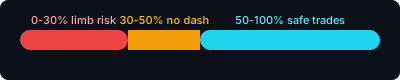
Protection is the hidden multiplier in Saber Unbound. Players often chase offense, combos, and pressure mechanics, but long-term progression depends just as much on your ability to avoid collapses. This guide teaches a practical defensive system verified in-game in June 2026, with one core principle: keep approximately 30% of your active attention on vulnerability bar state at all times.
That 30% rule is not a theory. It is an operational habit. If vulnerability awareness disappears during offense, your risk profile spikes and one bad exchange can erase the value of many good decisions. If vulnerability awareness stays active, your survivability and session stability improve dramatically.
Related pages:
- Gameplay flow: How to Play
- Beginner fundamentals: Beginner Guide
- Opportunity selection: How to Find
- Objective efficiency: How to Complete
- Resource support: How to Get
Why Protection Matters More Than Players Expect
Most progression loss comes from a small number of collapse moments, not constant small mistakes. Collapse moments often share the same pattern:
- Player gains advantage.
- Player overextends while vulnerable.
- Defensive awareness drops.
- Recovery options disappear.
- Momentum flips hard.
Protection strategy prevents this chain early. Instead of asking “How do I win every exchange?” ask “How do I avoid losing control when conditions deteriorate?”
That shift in question changes your outcomes.
The 30% Vulnerability Focus Rule
This guide centers on the 30% rule:
- During any active exchange, roughly 70% of attention can remain on offense, reads, and positioning.
- The remaining 30% must continuously track vulnerability bar status and exit conditions.
In practice, this means:
- You never attack without knowing your current vulnerability trend.
- You stop chain pressure sooner when risk rises.
- You prioritize safe reset windows before reaching crisis levels.
The number is a practical anchor, not a strict meter. The point is permanent defensive awareness, not occasional checks.
Build a Defensive Decision Ladder
When pressure rises, use a prebuilt ladder instead of improvising:
- Stable state: maintain normal probing and controlled conversion.
- Rising risk: shorten engagements and increase reset frequency.
- High risk: disengage proactively and recover spacing.
- Critical risk: avoid contest, prioritize full stabilization.
This ladder prevents panic and keeps responses consistent. You are not deciding from zero each time; you are following a known process.
Disengagement Is a Skill, Not a Retreat
Many players delay disengagement because they fear looking passive. That is costly. Good disengagement:
- Preserves accumulated advantage.
- Avoids vulnerability collapse.
- Creates new entry opportunities later.
Use disengage triggers:
- Vulnerability rises faster than expected.
- Opponent adapts to your current rhythm.
- Position quality drops and exits narrow.
- Mental focus dips after an error.
A timely disengage is often the highest-value decision in a difficult exchange.
Post-Mistake Recovery Protocol
After a bad exchange, do not instantly force redemption. Use this protocol:
- Stabilize movement and camera awareness.
- Re-establish spacing and safe lines.
- Recheck vulnerability trend.
- Resume with a probe, not a hard commit.
Players who skip this recovery protocol usually chain mistakes. Players who apply it often recover quickly and prevent larger losses.
Defensive Spacing and Positioning
Protection is easier when your position keeps options open. Defensive spacing goals:
- Avoid being pinned into narrow lines.
- Maintain enough room for controlled reset.
- Keep visual information clean.
Positioning errors often appear before vulnerability bar problems, so treat location quality as an early warning system.
Offensive Play With Defensive Integrity
Being defensive does not mean passive. You can stay aggressive while preserving protection by:
- Probing before full commitment.
- Ending conversion when probability drops.
- Preserving one step of exit planning in every exchange.
This style produces better long-session results than nonstop all-in aggression. You still create pressure, but you do it with risk awareness.
Vulnerability Bar Monitoring Habits
To make the 30% rule automatic:
- Call out vulnerability state mentally every few seconds.
- Tie offensive choices to bar thresholds.
- Build a habit of reset before high-risk zone.
At first this feels effortful. After repetition, it becomes natural and greatly reduces panic responses.
Defensive Session Template
Use this template for focused protection training:
Block 1: Awareness warm-up
- Practice tracking vulnerability and spacing without forcing fights.
Block 2: Controlled engagements
- Use probe, convert, reset loop.
- Apply the decision ladder consciously.
Block 3: Recovery drills
- Intentionally reset after each major exchange.
- Practice calm re-entry.
Block 4: Review
- Record one overcommit trigger and one successful disengage.
This structure trains defense as an active skill set.
Protecting Objective Momentum
Defensive mistakes do not only lose fights. They also delay objectives and reduce completion efficiency. To protect momentum:
- Avoid high-risk engagements before critical objective windows.
- Use safer routes when close to completion milestones.
- Read How to Complete for sequencing that lowers disruption.
Defense is progression insurance. Use it where stakes are highest.
Common Protection Mistakes
Watch for these recurring errors:
- Tracking offense and forgetting vulnerability.
- Staying in exchanges after conversion window closes.
- Treating disengage as failure.
- Re-entering immediately after emotional tilt.
- Ignoring positional deterioration.
Each error is correctable with awareness and preplanned rules.
June 2026 Defensive Observations
In June 2026 testing, the biggest separation between stable and unstable players was vulnerability management discipline. The strongest performers consistently:
- Reserved attention for vulnerability bar tracking.
- Disengaged before collapse.
- Re-entered with probes after resets.
Players who ignored these habits showed high variance and slower net progression, even with strong mechanics.
Integration With Full Playstyle
For maximum impact, connect this guide with:
- How to Play for tempo and conversion structure.
- How to Find for low-friction opportunity selection.
- How to Get for resource consistency.
Protection is not a separate mode. It is a constant layer across every action.
Final Protection Rule
Protect first, then pressure. Keep around 30% of your attention on vulnerability bar state, disengage before crisis, and treat recovery as part of winning. If you internalize these habits, your Saber Unbound sessions become steadier, your progression losses shrink, and your confidence in difficult moments rises sharply.